
Wikis and collaborative learning
Wikis in the classroom are a new concept being explored by teachers today. In the simplest form, wikis are a space on the internet where a person can put content that can then be added to/edited by other users. Collaborative learning, being the contribution of more than one person into the learning/education is the overall aim of using wikis in a class. As demonstrated through the following video.
*Click the link below or scroll to the end of this page to see the embedded video.
https://www.youtube.com/watch?v=1pR5yogCmkA
An easy way to understand what a wiki visually, is through the following concept map. A website is created, and various ‘authors’ contribute to the content entering their work into the ‘wiki engine.’
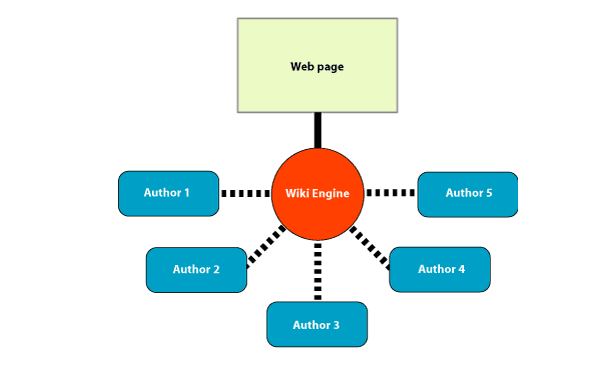
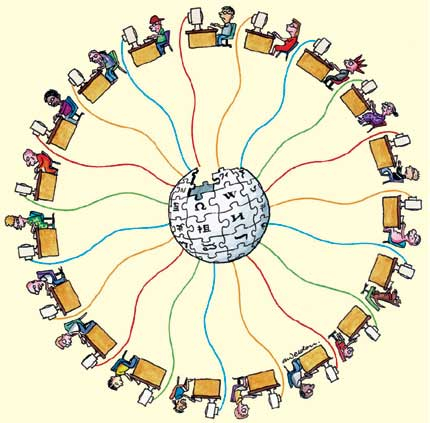
There are many potential ways to use wikis in the classroom for each subject taught in the classroom, as well as outside the classroom in a home environment. (eg. Assigned homework, assignments) Wikis connect students with each other, in a way that a normal class cannot. This allows students that might not feel comfortable voicing their opinions in front of everyone to ‘find their voice’ so to speak.
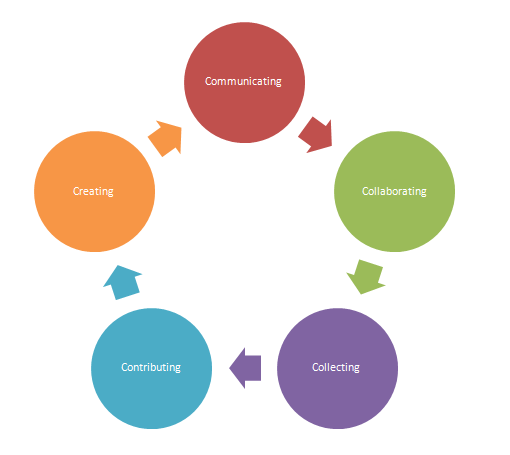
The main problem that I can see with using wikis for a class is that there is a certain amount of discipline needed to make sure that commenting on other students work for example does not get out of hand, or that the students are not distracted/do not waste too much time talking online to each other without focusing mainly on the content. (Getting stuck at the ‘communicating’ stage seen below.)
Howell (2012, p. 142) makes an important point. “We do need to be open and enthusiastic educators, who embrace and do not resist technology. That is the mindset we can all adopt.”
I strongly agree, technology and all that it holds such as collaborative learning through wikis needs to be accepted by teachers and embraced. Negativity towards using new programs and learning strategies such as collaborative learning instead of the traditional classroom learning (see the video below for an example of this) needs to be replaced by enthusiasm and open-mindedness.
*Click the link below or scroll to the end of this page to see the embedded video.
https://www.youtube.com/watch?v=EQKcxnFUMxk
As you can see, there is absolutely no student input in extreme traditional teaching. It is important to present content to students, and it is appropriate to do so in the above manner WITH the assistance of technology and tools such as wikis.
In summary the main advantage of using wikis in the classroom is that it engages students and encourages individual input. One of the only disadvantages of this style of collaborative learning is that it needs to have strict supervision (taking extra time) and the teacher needs to feel comfortable with using this level of technology before applying it to their classroom (which may require them to devote extra time to familiarise themselves with the software etc.)
I would definitely use wikis as a way to promote collaborative learning in my classroom when I become a teacher, having been given the chance to use them and to experience the advantages to them when I was a secondary student.
References:
Books:
Howell, J. (2012). Teaching with ICT: Digital Pedagogies for Collaboration and Creativity. South Melbourne: Oxford University Press. (p. 96)
Videos:
Wikis in the Classroom
https://www.youtube.com/watch?v=1pR5yogCmkA
Traditional Classroom
https://www.youtube.com/watch?v=EQKcxnFUMxk
Images:
Concept Map on wikis
https://recap.ltd.uk/Resources/wiki1.gif

Wikis connecting students worldwide
https://newwaysteaching.wikispaces.com/file/view/wiki_universo.jpg/151262601/wiki_universo.jpg

The Wiki Cycle
https://enc1101-56.wikispaces.com/file/view/New_wiki_wheel.png/192240012/New_wiki_wheel.png

The videos below are in the order that they are first mentioned.